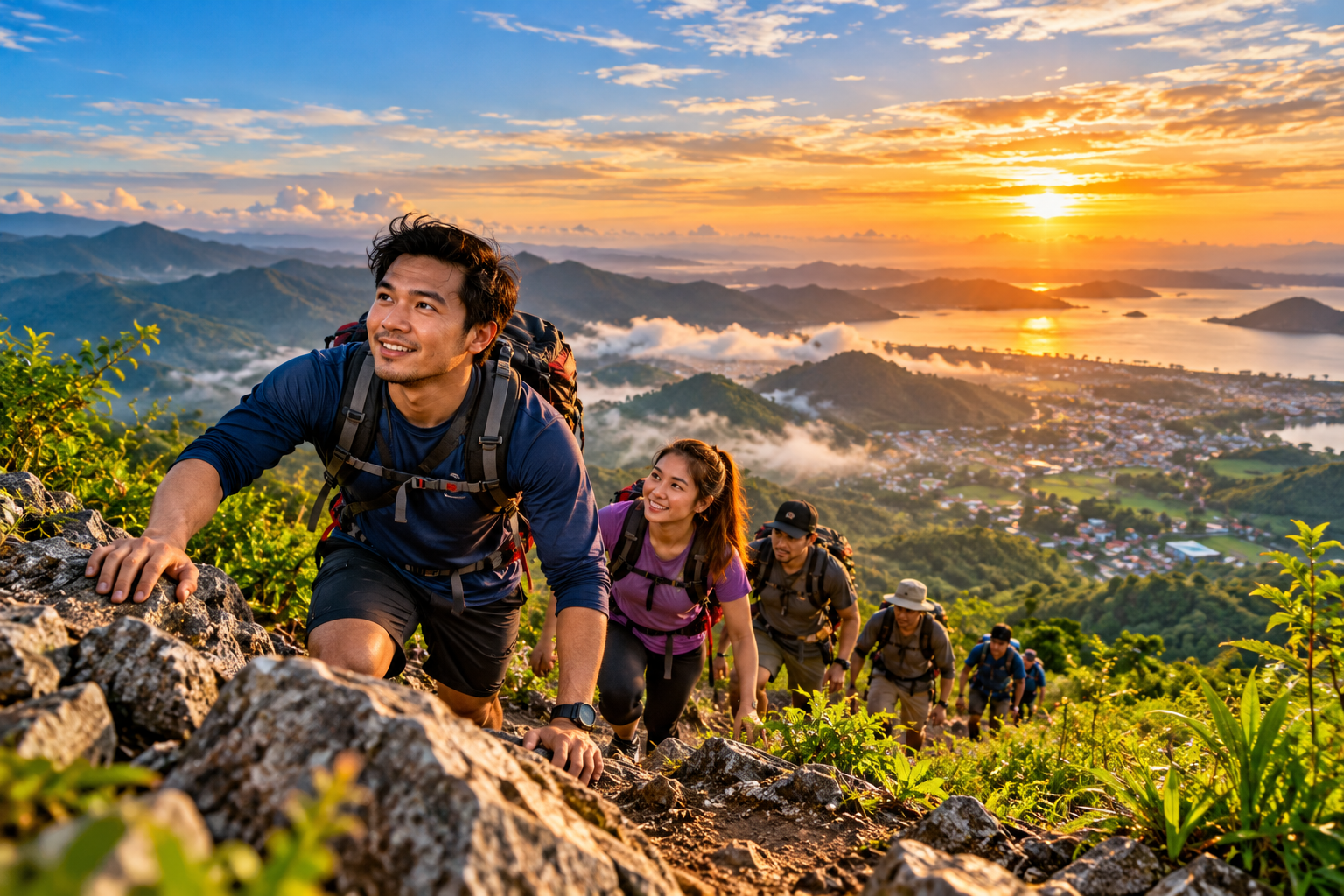
The alarm rang at three-thirty in the morning, but I was already awake. Today was the day I had been waiting for—the annual mountain climbing event organized by our barangay.
For weeks, the announcement had been posted on our barangay hall’s bulletin board and shared across Facebook. The event was open to residents and visitors who wanted to experience nature, challenge themselves, and help promote our local tourist spots.
At first, I wasn’t planning to join. I wasn’t exactly the athletic type. My idea of exercise was walking to the sari-sari store when someone asked me to buy snacks. But when my best friend, Marco, challenged me, I couldn’t resist.
“Unsa man, hadlok ka?” he teased. What, are you scared?
“Hadlok? Ako pa!” I replied confidently, even though my knees were already trembling just thinking about the climb.
Now, standing in front of the mirror, I checked my backpack for the fifth time. Two bottles of water, sandwiches, a raincoat, a flashlight, and a small first-aid kit. My mother had insisted on packing enough food to feed an entire basketball team.
“Ma, mountain climbing ra man ni, dili evacuation,” I told her.
She ignored me and added another banana.
By four-thirty, I was at the barangay covered court. The place was alive with excitement. Participants gathered in colorful hiking shirts, some wearing expensive trekking shoes while others wore ordinary rubber shoes. A group of teenagers took selfies, while several older residents stretched beside the registration table.
Our barangay captain welcomed everyone and reminded us to stay together, follow the guides, and respect the environment. A volunteer explained the route, emergency procedures, and the importance of carrying our own trash back down.
After a short prayer and warm-up exercises, we began our journey.
The first part of the trail was easy. We passed through familiar houses, vegetable gardens, and narrow paths lined with coconut trees. Neighbors waved from their windows, cheering us on as though we were competing in an international marathon.
“Padayon!” an elderly woman shouted.
I waved back proudly. At that moment, I felt like an athlete.
Twenty minutes later, I stopped feeling like one.
The trail became steeper, and the morning air grew humid. My legs started complaining, my shirt clung to my back, and Marco walked ahead as if he were taking a casual stroll through the mall.
“Bro, hinay-hinay lang!” I called. “Wala ta nagapasikat diri!”
He laughed and waited for me beside a large mango tree.
We continued climbing, sometimes stepping over exposed roots and carefully navigating muddy sections. Our guides reminded us to watch our footing and help anyone who needed assistance.
Along the way, I met Liza, a college student joining her first mountain climb, and Mang Ruben, a sixty-year-old farmer who knew the mountain trails better than anyone else in our group.
“First time nimo?” Mang Ruben asked.
I nodded.
“Then don’t focus on how far the summit is. Focus on your next step.”
His words sounded simple, but I remembered them whenever the trail became difficult.
As daylight spread across the hills, the scenery began to change. The trees opened into clearings where we could see the rooftops of our barangay far below. Mist floated between the mountains, and birds called from hidden branches.
We stopped at a designated rest area to drink water and eat breakfast. Someone shared boiled eggs, another offered bread, and my mother’s collection of bananas suddenly became the most popular food in the group.
“Abi nako para ra ni nako,” I said as everyone reached for one.
“Community sharing, bai!” Marco joked.
We laughed until our stomachs hurt more than our legs.
After the break, the final stretch began. The path narrowed, and every step demanded more effort. I considered giving up when we reached a steep incline covered with loose stones.
I sat on a rock and stared at the trail.
“Maybe the summit isn’t for me,” I muttered.
Liza, who had been struggling too, sat beside me.
“If we stop now, we’ll never know what the view looks like,” she said. “We don’t have to be the fastest. We just have to keep going safely.”
Mang Ruben agreed. Our guides checked on everyone, and we took another short rest before continuing at a manageable pace.
This time, I stopped comparing myself with Marco. I concentrated on my breathing, watched where I placed my feet, and accepted help when I needed it.
One step. Then another.
Eventually, the trees thinned, the trail leveled, and our guide announced that we had reached the summit.
I couldn’t speak at first.
The entire valley stretched beneath us. Our barangay looked like a tiny collection of colorful roofs surrounded by green fields and winding roads. Beyond it stood layers of mountains fading into the morning sky. Sunlight touched the distant hills, turning the mist golden.
I had seen pictures of beautiful landscapes before, but standing there was different. The cool breeze brushed my face, and the silence between the excited voices made everything feel peaceful.
We took photographs, exchanged congratulations, and gathered for a group picture. The barangay officials thanked the participants and reminded us that the mountain was not merely a tourist attraction. It was part of the community’s natural heritage, something we had a responsibility to protect.
Before descending, we collected our belongings and checked the area for litter. Nothing was left behind except our footprints and memories.
The trip down was not easy either. Our guides kept everyone together, and we moved carefully along the slippery sections. By the time we returned to the barangay hall, my legs felt like jelly, but my heart was full.
The event ended with a simple community gathering. People shared food, stories, and photographs. The barangay captain announced that future climbs would include more environmental activities, such as tree planting and trail cleanups.
Marco slapped my shoulder.
“So, champion, are you joining next year?”
I looked at my dusty shoes and aching legs.
“Of course,” I answered. “But next time, I’m bringing fewer bananas.”
Everyone burst into laughter.
That night, as I lay in bed, I thought about what the climb had taught me. I had joined because of a challenge, but I returned with something more meaningful. I learned that courage wasn’t about pretending to be fearless. It was about admitting when things were difficult, accepting help, and continuing when it was safe to do so.
The summit had been beautiful, but the people I met along the trail made the journey unforgettable.
And perhaps that was the real reward of our barangay’s mountain climbing event—not simply reaching the highest point, but discovering how far we could go when we moved forward together.




Wow